How Fordism and Fascism Gave Birth to Modern Car Culture
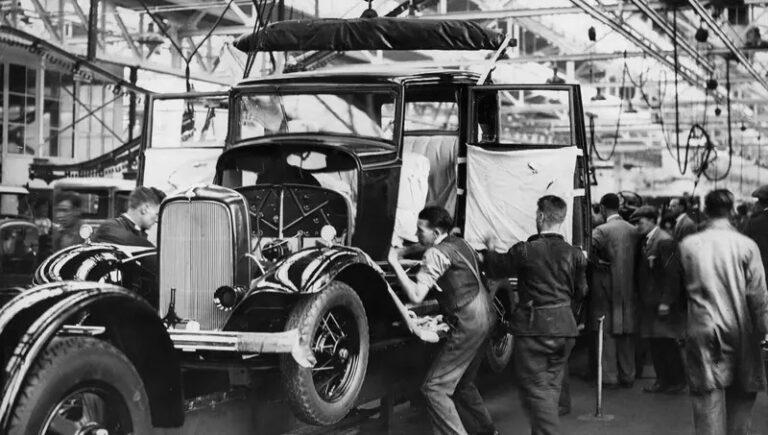
In 1934, writing from his prison cell, Antonio Gramsci reflected on the sweeping transformations reshaping industrial production in the United States. The rise of the automobile and the wider Fordist factory, he argued, signaled a new economic and moral order,
Résumé
Fordism's origins
In 1913, Henry Ford introduced the moving assembly line at his factories, a system where workers performed repetitive tasks while parts moved past them on conveyor belts.
This innovation, inspired by slaughterhouses where animal carcasses moved between workers, drastically increased productivity and disciplined laborers by reducing their movements to simple, standardized actions.
Ford also pioneered vertical integration, controlling every stage of production from raw materials like rubber to distribution, which lowered costs and allowed him to pay workers higher wages.
Before the five-dollar day introduced in 1914, Ford’s turnover rate was so high that the company had to hire nearly 1,000 workers annually to retain just 100.
This wage, described as a family wage, became the foundation of the male-breadwinner model, where men earned enough to support a family, reinforcing traditional gender roles and working-class respectability.
Lire l'analyse complète en 7 points →
Commentaires (0)
Connecte-toi pour commenter
Se connecterAucun commentaire pour le moment.
Voir aussi
Plus de contenus dans cette catégorie →Découvre plus de contenu sur Napseflow